
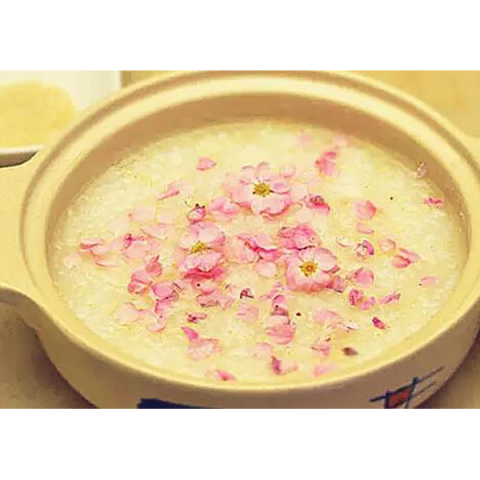

| Product name | Plum Blossom Congee |
|---|---|
| Descripción | It has a neutral nature, regulates liver qi, and stimulates the appetite. It is beneficial for those with poor appetite, and for healthy individuals it helps increase energy |
| Price | MXN$240 |
| Order quantity |
|
| Sum |
Plum Blossom Congee
(梅花粥 / Mei Hua Congee)
Spring Liver-Nourishing Medicinal Congee
(春季养肝用药粥)**
In Traditional Chinese Medicine (TCM), it is said that “spring is the season to nourish the liver” (春宜养肝).
During spring, diet should be prioritized to support liver health. It is important to consume balanced nutrients and foods rich in proteins and vitamins. Medicinal congee is also an excellent way to nourish the liver during this season.
Plum Blossom Congee
(梅花粥 / Mei Hua Congee / Plum Blossom Congee)**
Ingredients
- 5 g white plum blossoms (白梅花 / Bai Mei Hua)
- 80 g rice (粳米 / Jing Mi / Japonica rice)
Preparation
Cook the rice into congee.
Add the white plum blossoms and simmer for 2–3 minutes.
Consume once daily for 7 consecutive days.
Effects
This congee has a neutral nature, regulates liver qi, and improves appetite.
It is beneficial for individuals with poor appetite, and promotes increased energy in healthy individuals.
White Plum Blossoms (白梅花 / Bai Mei Hua)
“White plum blossoms” refer to the white flowers of Prunus mume.
As the characters imply—白 (white), 梅 (plum), 花 (flower)—the term denotes plum blossoms that bloom in white.
Characteristics & Background
• Botanical information
White plum blossoms come from certain cultivars of Prunus mume.
Most plum blossoms are white or pink, and some varieties such as “Manjeop Baekmaehwa (萬疊白梅花)” have layered petals.
• Cultural symbolism
In East Asian culture, plum blossoms symbolize purity, perseverance, integrity, and noble character because they bloom in late winter.
• Medicinal use
White plum blossoms are used in traditional medicine to regulate liver function, ease stomach discomfort, and relieve phlegm and cough.
They can be infused as tea or added to congee.
• Literature & art
Their elegant form and fragrance have inspired poets and painters throughout Chinese and Korean classical history.
Japonica Rice (粳米 / Jing Mi)
Jing Mi refers to the common short-grain Japonica rice, widely consumed as a staple in Korea, Japan, and China.
Main Features
• Appearance:
Short, round grains with a plump shape.
• Texture:
Sticky, glossy, soft when cooked; maintains chewiness even after cooling.
Ideal for rice balls, lunchboxes, and dishes requiring cohesive texture.
• Major Uses:
Staple steamed rice, congee, sushi, rice cakes, and various rice dishes.
• Nutritional content:
Rich in carbohydrates, with small amounts of protein, fat, vitamins, and minerals.
Comparison With Other Rice Types
• Indica rice (籼米 / Indica)
- Long and slender grains
- Less sticky, fluffy when cooked
- Common in Southeast Asian cuisine (e.g., curry rice, pilaf)
• Glutinous rice (糯米 / Nuo Mi)
- Same Japonica lineage but much stickier
- Opaque in appearance
- Used mainly for rice cakes, desserts, and sweet dishes
Additional Note (TCM Insight)
In traditional Chinese medicine, Jing Mi (粳米) is regarded as a medicinal grain that:
- Strengthens the spleen and stomach
- Relieves thirst
- Stops diarrhea
Thus, it is widely used in tonic congee prescriptions.


