

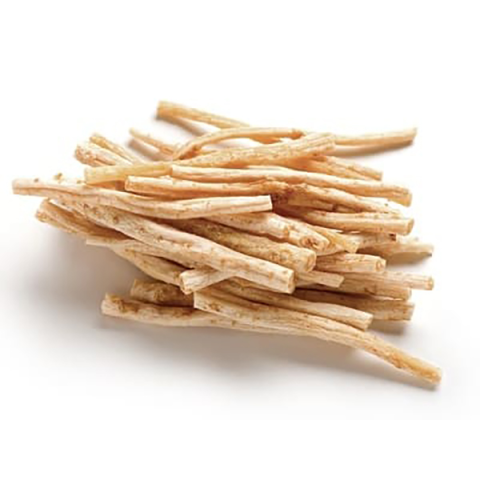

| Product name | Adenophora Root |
|---|---|
| Descripción | Chronic cough due to yin deficiency; coughing or spitting of blood from the lungs; dry cough with scanty phlegm; deficiency-heat sore throat; and thirst caused by the depletion of body fluids. |
| Price | MXN$500 |
| Order quantity |
|
| Sum |
Adenophora Root
沙参
Shashen
(沙参 Adenophora Root)
Adenophora stricta Miq. is a perennial herb of the family Campanulaceae, genus Adenophora.
The root is carrot-shaped and unbranched; the plant can grow up to 1 m tall, with an upright, unbranched stem. The inflorescences are narrow racemes or panicles; the pedicels are short; the calyx has entire or toothed lobes; the corolla is usually purple or blue; the filaments are widened into a plate at the lower part; the anthers are slender. The ovary is inferior with numerous ovules. The seeds are oval. It flowers from July to August.
The root is used medicinally. It is harvested in autumn by digging, removing the aerial parts and fine roots, scraping off the coarse outer bark, and drying immediately in the sun.
It is non-toxic, has a sweet and slightly bitter taste, and has effects of tonifying, dispelling internal heat and cold, clearing the lung and stopping cough. It is also used to treat cardiac and splenic pain, headache, and leukorrhea in women.
It mainly treats bronchitis, whooping cough, cough due to lung heat, and thick, yellow sputum. After boiling to remove the bitterness, the root can be eaten as food.
Morphological Characteristics
Perennial herb with white milky latex.
The root is carrot-like. Stems are 40–80 cm tall, unbranched, usually covered with short stiff hairs or long soft hairs, rarely glabrous.
- Basal leaves: heart-shaped, large, with long petioles.
- Stem leaves: sessile, or with very short winged petioles on the lower leaves. Leaf blades are elliptic or narrowly ovate, base cuneate or sometimes nearly rounded and blunt; apex acutely pointed or short-acuminate; margins irregularly serrate. Both surfaces sparsely covered with short hairs or stiff long hairs, or nearly glabrous. Leaf length 3–11 cm, width 1.5–5 cm.
Inflorescences are usually unbranched, forming a false raceme, or with short branches forming a very narrow panicle; rarely with long branches forming a normal panicle.
- Pedicels very short, usually less than 5 mm long.
- Calyx usually covered with short soft hairs or granular hairs, occasionally completely glabrous. The calyx tube is usually obovate, rarely obovoid-conical. Lobes are narrow and mostly awl-shaped, rarely linear-lanceolate, 6–8 mm long and up to 1.5 mm wide.
- Corolla broadly campanulate, blue or purple, outer surface glabrous or with stiff hairs, especially along the veins, 1.5–2.3 cm long. Lobes are about 1/3 of the corolla length, triangular-ovate.
- Floral disc short-tubular, 1–1.8 mm long, glabrous.
- Style usually slightly longer than the corolla, occasionally shorter.
The capsule is elliptic-globose or occasionally elliptic, 6–10 mm long.
Seeds are brownish-yellow, slightly flattened with a single ridge, about 1.5 mm long.
Flowering period: August–October. Chromosome number: 2n = 34.
The hairiness of the calyx is quite variable: most individuals have short hairs, others have soft hairs, granular hairs, or are glabrous. These variations form a continuous series.
Diagnostic features of this species include sessile leaves, false racemose or narrowly paniculate inflorescences, short pedicels, calyx generally hairy, and long, awl-shaped entire calyx lobes widest at the base.
Cultivation Techniques
1. Propagation by Seed
Divided into spring sowing and winter sowing:
- Spring sowing (North China): around April.
- Winter sowing: before the ground freezes in January.
Before sowing, plough and fertilize the field thoroughly.
Per hectare (1 hm²), apply 4,500–60,000 kg of compost or farmyard manure. After preparation, make beds 1 m wide.
Open shallow furrows at 40 cm row spacing, sow seeds evenly into the furrows, cover with 1–1.5 cm of soil, press lightly, and water. Keep the soil moist. Spring-sown seeds emerge after about two weeks. Winter-sown seeds germinate the following spring.
2. Field Management
- After seedling emergence, weed and loosen the soil in time.
- When seedlings reach about 3 cm in height, thin once.
- At 10–15 cm height, perform final thinning, leaving one strong plant every 10–15 cm.
To prevent lodging, during the growing period soil can be hilled up around the base while fertilizing, strengthening the root system.
Top dressing:
- At seedling stage, apply light, frequent fertilization (mainly manure) to maintain vigorous growth.
- Afterwards, apart from fertilizing once after withering each year and once before emergence, additional fertilization is needed three times in May, July and September, mainly using diluted human and animal manure.
When plants reach about 45 cm, pinch out the growing tip to control height, reduce nutrient consumption, and promote root growth.
3. Pest and Disease Control
- Root rot: spray with 50% Thiophanate-methyl (or similar fungicide) wettable powder at 1:500 dilution.
- Brown spot: spray with 65% Zineb or Zine-based wettable powder at 1:500 dilution.
- Insect pests: aphids, cutworms, etc., can be managed with appropriate insecticides according to standard agricultural practice.
4. Harvest and Storage
Roots are harvested 2–3 years after sowing. In autumn, dig out the roots, remove stems, leaves and fine roots, wash off soil, scrape off the outer bark while fresh using a bamboo chip, slice and dry in the sun.
Medicinal Value
1. Medicinal Source
The medicinal material Shashen (沙参) refers to the root of Adenophora stricta and some related species of the genus Adenophora (family Campanulaceae).
2. Processing (Pao Zhi)
Take the crude root, remove impurities and the basal stem (芦头), wash clean, moisten until soft, cut into thick slices, and dry.
(1) Honey-prepared Shashen (蜜沙参)
Modern processing:
- Dilute refined honey with an appropriate amount of hot water,
- Mix evenly with Shashen slices,
- Cover and let them absorb the honey thoroughly,
- Then heat in a wok over low flame, stir-frying until the slices become yellow-orange and no longer sticky.
- Remove and cool.
For every 100 kg of southern Shashen slices, use 25 kg of refined honey.
(2) Characteristics of the Prepared Slices
- Shashen (plain): round or nearly round thick slices. Surface yellow-white or off-white, with many irregular fissures forming a marbled pattern. Outer edge light brownish-yellow, wrinkled. Texture light. Odorless, taste slightly sweet.
- Honey-Shashen (蜜沙参): similar shape, but surface orange-yellow to caramel-yellow, occasionally with scorched spots, taste sweet.
Nature, Flavor, and Channels
- Flavor: sweet, slightly bitter
- Nature: slightly cold
- Channels entered:
- Lung meridian (肺经)
- Stomach meridian (胃经)
- Lung meridian (肺经)
Functions and Indications
Main functions:
- Nourish Yin and clear heat — 养阴清热
- Moisten the lung and transform phlegm — 润肺化痰
- Benefit the stomach and generate fluids — 益胃生津
Indications:
- Chronic cough due to Yin deficiency
- Consumptive cough with blood-streaked sputum
- Dry cough with scanty phlegm
- Sore, dry throat due to deficient heat (虚热喉痹)
- Thirst from depletion of body fluids
Usage and Dosage
- Internal use: decoction, 10–15 g (dried material)
- Fresh root: 15–30 g
- Can also be included in pills or powders.
Cautions and Contraindications
- Contraindicated in wind-cold cough (exogenous cold attacking the lung).
Classical notes:
- 《本草经集注》
“Antagonistic to Fangji (防己) and incompatible with Lilu (藜芦).”
- 《本草经疏》
“If the viscera have no real heat, and the cough is due to lung deficiency with cold invasion, it should not be used.”
Chemical Constituents
From the root of Shashen, four compounds have been isolated:
- β-sitosterol (β-谷甾醇, β-sitosterol)
- β-sitosterol-O-β-D-glucopyranoside (β-谷甾醇-β-D-吡喃葡萄糖甙)
- Taraxerone (蒲公英赛酮, taraxerone)
- Octacosanoic acid (二十八碳酸, octacosanoic acid)
Pharmacological Actions
1. Effects on Immune Function
Intraperitoneal injection of a decoction of Apricot-leaf Shashen (杏叶沙参) at 0.5 g per mouse significantly:
- Increases the number of lymphocytes and T cells in peripheral blood,
- Tends to increase lymphocytes and T cells in the thymus,
- Significantly enhances the phagocytic rate of peritoneal macrophages,
- Increases spleen weight but decreases spleen lymphocyte and T-cell counts.
These results suggest that Shashen can:
- Enhance cellular and non-specific immunity,
- Suppress humoral immunity,
- Help regulate immune balance.
Shashen also increases lymphocyte transformation rate.
2. Expectorant Effect
In rabbits, oral administration of a Shashen decoction at 1 g/kg shows a definite expectorant effect that can last for more than 4 hours, though its intensity is weaker than that of some stronger expectorant herbs (such as certain “purple-flower” species mentioned for comparison).
3. Antifungal Effect
An aqueous extract of Shashen (1:2) shows in vitro inhibitory effects on several dermatophytes, such as:
- Trichophyton mentagrophytes (奥杜盎小芽胞癣菌)
- Trichophyton verrucosum (羊毛状小芽胞癣菌)
and other skin fungi, with varying degrees of inhibition.
4. Cardiotonic Effect
A 1% Shashen infusion exerts a clear cardiotonic effect on the isolated toad heart, increasing the amplitude of contraction, with an effect lasting about 5 minutes.
Habitat and Ecology
Shashen commonly grows:
- In low mountain grasslands,
- In rock crevices,
- On grasslands at 600–700 m altitude,
- And on open mountain slopes or in forests at 1,000–3,200 m.
It prefers warm or cool climates, is cold-tolerant, and although drought-resistant, it still needs adequate moisture during the growing season. At the seedling stage, drought often causes seedling death.
Best cultivated in deep, fertile, humus-rich, well-drained sandy loam.
Distribution in China includes:
- Jiangsu (江苏)
- Anhui (安徽)
- Zhejiang (浙江)
- Jiangxi (江西)
- Hunan (湖南)
and other provinces.
Herb Name Glossary (Chinese + English)
- 沙参 (Shā Shēn) – Shashen, Adenophora root
- 杏叶沙参 (Xìng Yè Shā Shēn) – Apricot-leaf Shashen (a species of Adenophora)
- 防己 (Fáng Jǐ) – Fangji, Stephania root (Radix Stephaniae)
- 藜芦 (Lí Lú) – Lilu, Veratrum root (Veratrum spp., traditionally incompatible with many tonics)


