

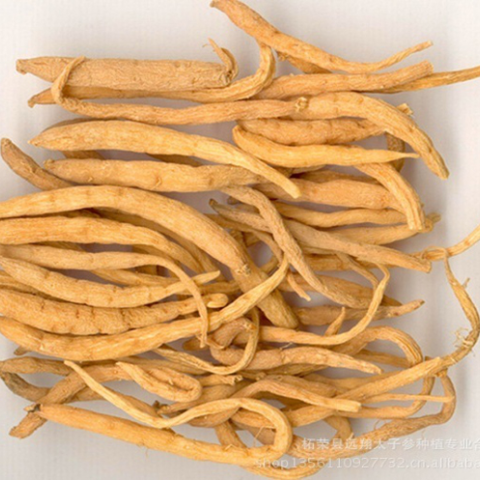

| Product name | Pseudostellaria Root |
|---|---|
| Descripción | It treats spleen deficiency with fatigue and heaviness, easy tiredness, poor appetite, post-illness weakness, deficiency of qi, yin, and yang, spontaneous sweating, thirst, and dry cough caused by lung dryness. |
| Price | MXN$500 |
| Order quantity |
|
| Sum |
Pseudostellaria Root
太子参
Tai zi shen
(太子参)
English name: Pseudostellaria Root / Prince Ginseng
Latin name: Pseudostellaria heterophylla (Miq.) Pax ex Pax et Hoffm.
Family: Caryophyllaceae (石竹科)
Overview(概述)
Taizishen (太子参) is the dried tuberous root of Pseudostellaria heterophylla, a perennial herb in the Caryophyllaceae family.
It is distributed in Fujian, Liaoning, Inner Mongolia, Hebei, Shaanxi, Shandong, Jiangsu, Anhui, Zhejiang, Jiangxi, Henan, Hubei, Hunan, Sichuan, and other provinces of China.
Taizishen has the functions of tonifying Qi, strengthening the spleen, promoting body fluids, and moistening the lungs.
It is commonly used for spleen Qi deficiency, fatigue, poor appetite, weakness after illness, Qi–Yin deficiency, spontaneous sweating, thirst, and dry cough due to lung dryness.
Medicinal Part(入药部位)
- Dried tuberous root
(干燥块根 Dried tuberous root)
Properties(性味)
- Taste: Sweet, slightly bitter
(味甘、微苦 sweet, slightly bitter) - Nature: Neutral
(性平 neutral)
Meridian Tropism(归经)
- Enters the Spleen Channel (脾经 Spleen)
- Enters the Lung Channel (肺经 Lung)
Functions(功效)
- Tonifies Qi and strengthens the spleen(益气健脾)
- Generates fluids and moistens the lungs(生津润肺)
Indications(主治)
Used for:
- Spleen Qi deficiency with fatigue(脾虚体倦)
- Poor appetite(食欲不振)
- Weakness after illness(病后虚弱)
- Qi and Yin deficiency(气阴不足)
- Spontaneous sweating and thirst(自汗口渴)
- Dry cough due to lung dryness(肺燥干咳)
Formula Combination(相关配伍)
Formula for spontaneous sweating(治自汗方)
- Taizishen 太子参 — 3 qian(approx. 9 g)
- Fuxiaomai 浮小麦 (Semen Tritici Levis) — 5 qian(approx. 15 g)
Decoction taken warm.
Dosage(用法用量)
- 9–30 g in decoction
Harvesting & Processing(采集加工)
- Harvested in summer when most stems and leaves have withered
- Washed clean, fibrous roots removed
- Briefly blanched in boiling water, then sun-dried
or dried directly without blanching
Botanical Description(植物特征)
- Perennial herb, 15–20 cm tall
- Tuberous roots: Long fusiform
- Stem:
- Lower part purple, 4-angled
- Upper part nearly round, green, with two rows of fine hairs
- Nodes slightly swollen
- Lower part purple, 4-angled
- Leaves: Opposite, somewhat fleshy
- Lower leaves: spatulate or oblanceolate, apex pointed, base tapering
- Upper leaves: ovate-lanceolate to long-ovate
- Leaves near stem apex: usually 4, forming a cross-shaped whorl
- Margins slightly wavy
- Lower leaves: spatulate or oblanceolate, apex pointed, base tapering
Flowers
Two types:
- Cleistogamous flowers (闭锁花)
- Born on axils of lower leaves
- Small, pedicels hairy
- 4 sepals, no petals
- Born on axils of lower leaves
- Normal flowers(普通花)
- 1–3 terminal flowers
- White
- Pedicels 1–4 cm, purple
- Sepals 5, lanceolate, hairy on back
- Petals 5, obovate, 2-lobed at apex
- Stamens 10, anthers purple
- Pistil 1, styles 3, capitate stigma
- 1–3 terminal flowers
Fruits
- Capsule nearly spherical, splitting into 5 valves
- Seeds flattened, with wart-like protrusions
Phenology
- Flowering: April–May
- Fruiting: May–June
Growth Environment(生长环境)
Occurs in:
- Fujian, Liaoning, Inner Mongolia, Hebei, Shaanxi
- Shandong, Jiangsu, Anhui, Zhejiang
- Jiangxi, Henan, Hubei, Hunan, Sichuan
Typically grows at 800–2700 meters in:
- Shaded, moist forest valleys
- Humid mountainsides
Also found in Japan and Korea.
Medicinal Characteristics(药材性状)
- Shape: Long fusiform or slender cylindrical, slightly curved
- Length: 3–10 cm
- Diameter: 0.2–0.6 cm
- Color: Yellowish-white, smooth
- Slight longitudinal wrinkles
- Root-mark depressions evident
- Stem scar present at apex
- Texture: Hard and brittle
- Cross-section: Flat, yellowish-white, keratinous or powdery
- Odor: Slight
- Taste: Slightly sweet


