
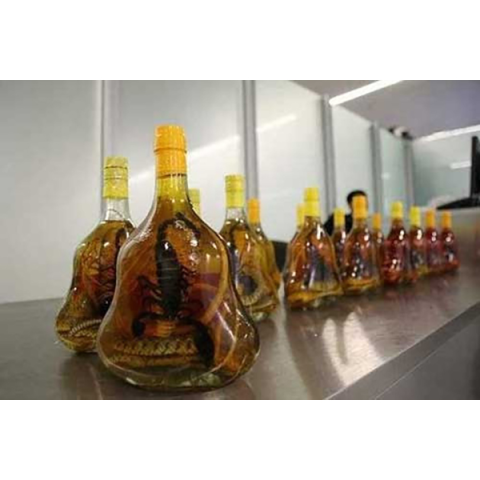

| Product name | Sparrow Vitality Enhancing Medicinal Wine |
|---|---|
| Descripción | It warms and tonifies kidney yang. It is used for symptoms such as chills, cold pain in the lower back and knees, dizziness, and frequent urination |
| Price | MXN$500 |
| Order quantity |
|
| Sum |
Sparrow Vitality Enhancing Medicinal Wine
(麻雀壮阳酒 Sparrow Yang-Tonifying Wine)
— A warming, moistening tonic wine that tonifies the kidneys and enhances male vitality
(温润补肾壮阳酒)
Ingredients (配方)
|
中文 |
English |
Korean |
Amount |
|
麻雀 |
Sparrow |
참새 |
250 g |
|
白酒 |
White liquor (Baijiu) |
백주 |
1000 ml |
Preparation Method (制作方法)
Remove the feathers, internal organs, head, and legs of the sparrow. Wash thoroughly.
Steam the cleaned sparrows, then let them cool and dry completely.
Place them in a container, pour in baijiu, seal tightly, and steep for 3 months.
Functions & Indications (功效与主治)
- Warms and tonifies kidney-yang (温补肾阳)
- Used for
• Aversion to cold
• Cold pain in the lower back and knees
• Dizziness
• Frequent urination
Dosage (服法)
Take 20–30 ml, twice a day.
Notes (说明)
- Sparrow is sweet and warm in nature (甘温).
Classical materia medica records note that it strengthens yang and replenishes essence (壮阳益精),
warms the lower back and knees (暖腰膝), reduces frequent urination (缩小便),
and treats yang-deficiency fatigue, chronic emaciation, frequent urination,
uterine bleeding, and leukorrhea. - Particularly effective for sexual dysfunction, especially erectile dysfunction.
- Because it is warming, it is most beneficial when consumed in winter.
Contraindicated for individuals with yin-deficient internal heat and for pregnant women. - Dietary therapy:
Prepare 5 sparrows, remove feathers and organs, finely chop, cook with rice porridge,
and add scallions, salt, and seasoning. Consumed on an empty stomach,
this is traditionally used for erectile dysfunction and premature ejaculation. - Another classical prescription:
Remove feathers and organs from 1 sparrow, place 1 croton seed kernel (巴豆仁) inside the abdomen,
bake between clay tiles, grind into powder, and combine with good liquor and yellow beeswax
to form pills about the size of a coin.
Take 10–20 pills per dose to treat red and white dysentery.
For red dysentery, take with Licorice Decoction; for white dysentery, take with Dry Ginger Decoction.
Sparrow (Passer montanus)
The Eurasian Tree Sparrow is a small bird belonging to the order Passeriformes and family Passeridae.
Widely distributed across Eurasia, it is one of the most common birds around human living environments.
Small in size and highly adaptable, it is considered a wild species closely associated with human life.
Key Characteristics
Appearance
- Length: 12–15 cm
- Weight: 20–26 g
- Distinguished by:
- Dark chestnut head
- Brown back with black streaks
- Black cheek spot (typical of the Eurasian tree sparrow)
- Black throat patch
- Dark chestnut head
- Males and females look almost identical.
Diet
Omnivorous:
- Grains, grass seeds, fruits
- During breeding season → consumes large amounts of insects and larvae to feed chicks
Habitat
Thrives in a wide range of environments:
- Plains, hills, farmlands, parks, cities
- Nests in roof crevices, tree holes, rock gaps
Behavior
- Lives in flocks
- Extremely alert while foraging
- A non-migratory resident species
- Typically remains within a fixed territory
Ecological Role & Conservation Status
Ecological Role
- Spreads seeds → aids plant propagation
- Eats insects → helps control pests
- Population fluctuations serve as an ecological indicator of environmental health
Relationship with Humans
Historically misclassified as one of the “Four Pests” due to crop damage,
but later recognized as more beneficial than harmful because it helps control insect pests.
Protection Status
- China: Listed in the National Directory of Terrestrial Wildlife Under Beneficial or Important Economic/Scientific Value
- Global: IUCN Red List → Least Concern (LC)
Cultural Significance
Sparrows symbolize:
- Joy
- Happiness
- Perseverance
- Fertility
World Sparrow Day (March 20) aims to promote conservation and public awareness.
Baijiu (White Liquor, 白酒)
Baijiu is a traditional Chinese distilled spirit made from grains.
Crystal clear in color, with alcohol content ranging from 35–60%,
it is known in Korea as bakju or bbaegal.
Main Aroma Categories of Baijiu
1. Sauce Aroma (酱香型)
- Deep, complex, soy-sauce-like fragrance
- Representative brands: Kweichow Moutai, Langjiu
2. Strong Aroma (浓香型)
- Most widely consumed type
- Fruity aromas (pineapple, melon) with a sweet, full taste
- Brands: Luzhou Laojiao, Wuliangye, Shuijingfang
3. Light Aroma (清香型)
- Clean, refreshing taste with subtle floral or apple notes
- Good for beginners
- Brands: Fenjiu, Erguotou
4. Rice Aroma (米香型)
- Made mainly from glutinous rice
- Smooth and mildly sweet
Famous Brands
- Kweichow Moutai: premium ceremonial liquor, highly prestigious
- Wuliangye: made from five grains, rich and complex
- Luzhou Laojiao: ancient brand known for high-quality strong-aroma baijiu
Purchase Information
Baijiu is available both online and in physical stores.
Prices vary widely depending on brand and vintage.
Examples:
- Luzhou Laojiao Tequ 500 ml → approx. IDR 750,000
- Kweichow Moutai 2021 500 ml → approx. IDR 7,500,000