
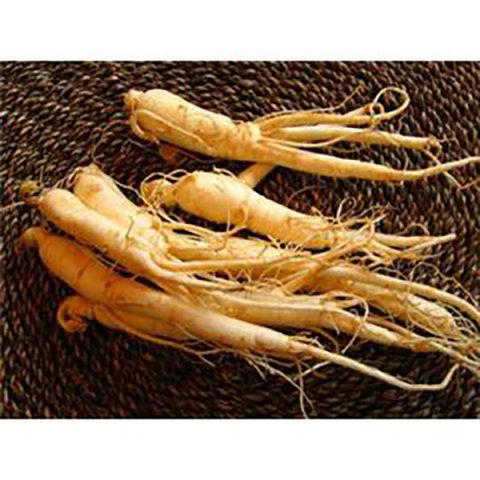

| Product name | American Ginseng |
|---|---|
| Descripción | 중추신경계 기능 강화,심혈관계 보호,면역력 증강, 혈액 순환·혈액 점도 개선, 당뇨병 보조 치료, 심근 강화,혈압 조절, 암세포 억제, 면역 기능 향상, 소화 기능 개선, 만성 위장 허약증 |
| Price | MXN$500 |
| Order quantity |
|
| Sum |
American Ginseng
(西洋参 · Panax quinquefolius L.)
American ginseng (Panax quinquefolius L.) is a perennial herb of the genus Panax in the family Araliaceae.
Its root is cylindrical or spindle-shaped; the leaves are broadly ovate or obovate with coarse serrations on the margin. The inflorescence is an umbel, calyx green and bell-shaped; petals green-white; anthers ovate or oblong. The berry is a flattened sphere, bright red when ripe. Flowering occurs from July to August, and fruiting in September.
American ginseng was first discovered in forest along the Atlantic coast in the Montreal region. It was named for its place of origin. It belongs to the same genus as Asian ginseng but is a different species.
American ginseng is native to North America, particularly southern Canada and northern United States. It is now cultivated in Jilin, Beijing, Shandong, Shaanxi, Shanxi, and in high-altitude mountain areas of southern provinces such as Fujian and Yunnan.
It prefers shady, moist environments, is sensitive to strong light and high temperatures, and is best grown in deep, well-drained, loose, fertile sandy loam with slightly acidic to neutral pH. Propagation is mainly by seed.
American ginseng was first recorded in the Supplemented Essentials of Materia Medica (《增订本草备要》). It is bitter and cold and clears by draining, sweet and cold and tonifies by cooling, and enters the Heart, Lung and Kidney channels. It is a “cold-tonifying” herb: it both tonifies Qi and nourishes Yin, and also clears fire and generates fluids, chiefly treating patterns of Qi and Yin deficiency.
American ginseng can also be used for cardiovascular diseases, boosting immunity, and inhibiting the proliferation of cancer cells. It was once called “Green Gold”. It is said that during the Kangxi reign, the Emperor strictly prohibited logging in the Changbai Mountains, making Asian ginseng extremely scarce and expensive. At that time, American ginseng entered the Chinese market, was highly prized, and could be exchanged for large amounts of gold, hence the name “Green Gold.” Empress Dowager Cixi was especially fond of American ginseng and reportedly cured diarrhea with it; afterward, this herb became widely popular.
Botanical History
1. Discovery
American ginseng was discovered under the inspiration of Asian ginseng (Panax ginseng C. A. Meyer).
In 1714, French missionary Joseph François Lafitau (often spelled Lafitau)—referred to here as “Yatus” in some Chinese sources—wrote an article titled “On the Tartar Plant Ginseng” describing the external morphology and uses of Chinese ginseng, with an illustration of the plant, which was published in the Philosophical Transactions of the Royal Society of Britain.
A copy of this journal reached French missionary Father Joseph-François Lafitau living in Montreal, Canada. Based on the description and illustration, he reasoned that similar plants must exist in Canadian forests. With the help of local Indigenous people, after two years of searching, in 1716 he finally found a plant in the forests near Montreal whose morphology resembled Asian ginseng: this was American ginseng.
2. Naming History
In the early days, American ginseng (“Western ginseng”) was shipped from French or British colonies to East Asia and then sold to China.
The Confucian physician Wang Ang of the Qing dynasty included American ginseng for the first time in a materia medica text in “Illustrated Essentials of Materia Medica” (补图本草备要), where he wrote under the entry: “Produced in the Great Western Ocean in France—called French ginseng (法兰参).”
Qing physician Zhao Xuemin in “Supplements to the Compendium of Materia Medica” (本草纲目拾遗, 1765, Qianlong 30) largely repeated the same description, and later materia medica works continued this view. The Chinese name “Western Ocean Ginseng” (西洋参) thus became established.
Because American ginseng was initially an imported medicinal, people distinguished it by origin: that from Canada, and that from the United States, which was nicknamed “Flag Ginseng” (花旗参) after the Stars and Stripes.
On December 20, 1757, Emperor Qianlong ordered the closure of the Jiangsu, Zhejiang, and Fujian customs; Guangzhou became the only open port for trade between China and the West. This pattern lasted for 85 years, until the Treaty Ports after the Opium War. During this period of single-port trade, American ginseng became an important commodity and was also called “Guangdong Ginseng”.
3. Cultivation History
In 1716, Father Lafitau hired Indigenous people to gather large quantities of wild American ginseng and shipped it to China for sale. At that time, American ginseng fetched prices comparable to gold in the Chinese market. Later, wild American ginseng was successively found in southeastern Canada and eastern United States.
Continuous overharvesting severely damaged natural resources and drastically reduced wild populations. To protect wild resources, some local governments in the United States listed wild American ginseng as an endangered plant and, in 1889, began artificial cultivation.
In China, in 1948, scientist Chen Fenghuai at Lushan Botanical Garden in Jiangxi introduced seeds from Canada for trial cultivation. However, due to war and lack of funds, the work stopped at the flowering and fruiting stage.
After the founding of the PRC, because China and the U.S. had not yet established diplomatic relations, importing seeds of American ginseng (“Flag ginseng”) was restricted. In 1975, Premier Zhou Enlai personally inquired about American ginseng and advocated research on its introduction. Under his guidance, the State Science and Technology Commission, Ministry of Health, and Ministry of Commerce jointly launched Project “7510,” beginning scientific research on introducing American ginseng.
In 1975, Chinese-American Huang Peiyu brought 10 pounds of American ginseng seed back to China and handed it to the Chinese Academy of Agricultural Sciences. Under Project 7510, trial cultivation began in different climate regions of China. Jilin Provincial Science Committee’s medicinal research institute received 4 pounds of seed, which were distributed to the state-run First and Second Ginseng Farms in Ji’an. Under the persistent work of deputy farm director Qian Shaojun, successful introduction was achieved in 1978.
Also in 1975, the Chinese Academy of Sciences obtained 8 pounds of American ginseng seed and 150 seedlings from the U.S. via special channels. The Institute of Botany, together with units in Jilin, Liaoning, Beijing, Jiangxi and other provinces, undertook trial introduction and domestication.
In 1977, a symposium on the introduction and domestication of American ginseng was held at the Zuojiate Specialty Research Institute in Jilin Province, attended by 24 people from 14 units in Beijing, Jilin, Liaoning, Henan, Jiangxi and others. The meeting summarized experience and concluded that, after two years of trials, Northeast China and some other regions have suitable climate and soil and good cultivation techniques, so American ginseng could take root in China.
In September 1980, a formal evaluation meeting on introduction and domestication results was held at the same institute. Based on the ecological traits of American ginseng, it was concluded that areas north of the Yangtze River and south of 45°N, as well as high-altitude mountain areas in central and southwestern provinces, were suitable for trial cultivation.
By 1990, China had formed four major American ginseng cultivation regions: Jilin, Shaanxi, Beijing, and Shandong, covering 15 provinces and dozens of counties.
In 1997, under the sponsorship of the State Administration of Traditional Chinese Medicine, a national conference on production, processing, and trade of American ginseng was held in Shanghai. It was the largest such meeting since the first successful introduction and marked the vigorous development of China’s American ginseng cultivation and processing industries, making China the third largest producer and processor of American ginseng and its products in the world.
Morphological Characteristics
Underground Parts
The root system of American ginseng consists of a taproot (main root), lateral roots, fibrous roots, adventitious roots, and a rhizome (“crown” or “neck,” 芦头).
- Taproot
Fleshy, yellowish-white to earthy off-white. Its shape varies with age and environment, generally spindle-shaped, sometimes cylindrical. There are transverse rings or wrinkles of varying depth and thickness. - Lateral roots
Also called side roots, mostly arise from the lower part of the taproot. Growers in Northeast China call them “ginseng legs” (参腿). Some plants have few lateral roots, others quite many. - Fibrous roots
Fine hair-like roots arising from the lateral roots. Small wart-like nodules often grow on them—Northeast farmers call these “pearl nodules” (珍珠疙瘩). - Adventitious roots
Also called “ginseng nails or pegs” (参丁). Each plant has a variable number, usually 2–3, sometimes 4–5, and some have none. They are typically found between the taproot and the rhizome. If the taproot becomes diseased and decays, the adventitious roots can quickly grow and develop into spindle-shaped roots similar in size to the taproot, replacing its function. - Rhizome (“Crown”, 芦头)
This is the rootstock at the top of the main root. Each summer–autumn, typically one bud (rarely 2–3) develops at its apex. The bud is usually white and shaped like an eagle’s beak, with the tip curved downward. The next spring it sprouts into the aerial plant.
After the aboveground stem withers, a depressed stem scar remains on the rhizome—called a “crown scar” (芦碗). Generally, one crown scar forms each year, so the number of crown scars is an important indicator of the plant’s age.
In addition, each node on the rhizome has an undifferentiated dormant bud. If the bud is damaged by injury or pests, 1–2 dormant buds can grow out to replace it and form new aerial shoots the following year.
Aboveground Parts
The aboveground parts are composed of stem, leaves, flowers, fruits, and seeds.
- Stem
The stem is upright, cylindrical, smooth, hairless, green or dark purplish-green. Its height varies with plant age.- One-year-old plants have no true stem, only a compound leaf with three leaflets about 5 cm tall.
- Two-year-old plants with only one compound leaf also have no obvious stem; only when they bear two leaves does the stem become distinct.
- As the plant ages, the stem becomes taller. Four- to five-year-old plants usually have stems 11–25 cm tall.
- One-year-old plants have no true stem, only a compound leaf with three leaflets about 5 cm tall.
- Leaves
Leaves are generally palmately compound with five leaflets. The leaflets are obovate or ovate, thin-textured, with coarse, irregular serrations along the margin. In each compound leaf, the central leaflet is the largest, the two side leaflets intermediate, and the outermost two the smallest.
The number and size of compound leaves increase with age:
-
- One-year-old plants: one compound leaf with three leaflets
- Two-year-old: one or two compound leaves with five leaflets
- Three- to five-year-old: 3–5 whorled compound leaves, each with five leaflets.
- One-year-old plants: one compound leaf with three leaflets
- Flowers
A flowering stalk arises from the center of the stem apex, bearing an umbel of many small flowers. The stalk is slightly longer or equal to the leaf petioles. The calyx is green and bell-shaped, with 5 stamens and 1 pistil in each flower. - Fruits and Seeds
The fruit is a kidney-shaped berry-like drupe. It begins green and turns bright red or dark red and glossy when mature, containing 1–3 seeds, most commonly 2. Seeds are white, flattened kidney-shaped, with a rough, hard seed coat and a water-absorption pore.
Seed size:
-
- Length: 0.6–0.7 cm
- Width: 0.45–0.5 cm
- Thickness: 0.25–0.3 cm
- Length: 0.6–0.7 cm
Thousand-seed weight:
-
- Fresh seeds: 55–60 g
- Air-dried: 35–38 g
- Stratified, cracked seeds: 60–70 g.
- Fresh seeds: 55–60 g
Difference from Related Species
- American Ginseng (西洋参 · Panax quinquefolius)
The flowering stalk is nearly as long as or slightly longer than the leaf petioles. The leaflets are obovate; veins on the upper surface bear little to no stiff hairs; serrations along the margin are irregular and coarse. - Asian Ginseng (人参 · Panax ginseng C. A. Meyer)
Differs in leaflet shape, hairiness, and serration morphology, as well as in ecology and chemical profile.
Growing Environment
Native Habitat
- Canada
Mainly in the St. Lawrence River basin.- January average temperature: –12 to –4 °C
- July average: 16–21 °C
- Precipitation in all seasons: 1016–1270 mm/year
- Frost-free period: 100–140 days
- Natural vegetation: mixed coniferous and broad-leaved forests.
- January average temperature: –12 to –4 °C
- United States
Mainly east of 100° W longitude.- January temperatures near 0 °C; northern areas can be lower during cold waves
- July average: ~21 °C; mountain temperatures decrease with altitude
- Average rainfall: ~1150 mm, mainly in summer
- Vegetation: deciduous forests dominated by walnut and oak.
- January temperatures near 0 °C; northern areas can be lower during cold waves
In northern production states like Wisconsin, Michigan, and Minnesota, annual precipitation is 800–1000 mm, frost-free period 100–140 days in the north and 140–200 days in the south. In eastern coastal states (Massachusetts, New York, Pennsylvania), soils are relatively poor and rainfall highly variable (generally 800–1000 mm, some coastal areas 1000–2000 mm), with frost-free periods of 160–200 days. In central and southern states (Ohio, Indiana, Illinois, Missouri), soils are deep and fertile, frost-free period 150–180 days, rainfall 700–1000 mm.
Conditions for Introduction
- Soil
Prefers loose, deep, fertile soil rich in humus, with good aeration, water permeability and water-holding capacity—loam, sandy loam, or forest brown earth with good aggregate structure.
Optimal pH: 5.5–7.0, organic matter > 0.8%. - Light
Light is essential to growth, but American ginseng evolved under forest canopy as a semi-shade species. It requires weak, diffuse light and dislikes strong or direct midday sun, which can cause leaf burn.
Recommended shading (light transmittance):
-
- Year 1–2: 10–15%
- Year 3–4: 15–20%
- Year 1–2: 10–15%
- Temperature
Temperature strongly affects growth:- Emergence: air temperature ≥10 °C, soil temperature at 10 cm ≥7 °C
- Normal growth: air >20 °C, soil at 10 cm ~15 °C
- Flowering and fruiting: air ~28 °C, soil at 10 cm ~20 °C
- Senescence: air 12–14 °C or lower, soil at 5 cm ~10 °C
- Emergence: air temperature ≥10 °C, soil temperature at 10 cm ≥7 °C
So the optimal temperature range for the entire growing season is 10–28 °C, with aboveground growth lasting 130–150 days. Temperatures too high or too low reduce water and nutrient absorption and affect transpiration, photosynthesis, and respiration.
- Water
Requires relatively high air humidity and annual precipitation around 1000 mm. In dry, low-humidity areas with large diurnal temperature differences, plants grow poorly. Insufficient water reduces yield and vigor and increases disease susceptibility; too much water and bed flooding are also harmful. Soil moisture should be about 60–70% of field capacity.
Distribution
- Native Range
American ginseng is native to North America, naturally distributed in forests between 30–48° N and 67–95° W: southeastern Canada and eastern United States, including Montreal and Quebec in Canada, and New York and Missouri in the U.S. - Introduced Regions
It can be cultivated in Asia, the Americas, and Europe roughly between 30–47° latitude north or south. In the U.S., it is grown mainly in the Great Lakes region (around Lakes Superior, Michigan, Huron, Erie, and Ontario) and adjacent states: New York, Pennsylvania, Ohio, Michigan, Indiana, Illinois, Wisconsin, Minnesota, plus coastal states (Maine, Massachusetts, Maryland, North Carolina), central and southern states (Missouri, Kentucky, Tennessee), and coastal California.
In China it is cultivated in Northeast and North China (Jilin, Beijing, Shandong, Shaanxi, Shanxi) and in southern high-altitude mountain regions (Fujian, Yunnan), where suitable “mountain microclimates” exist.
Propagation
Pre-sowing Preparation
- Site selection
Choose fertile, loose soil with good physical and chemical properties, strong water and nutrient retention, and good drainage and irrigation. It is best to follow cereals (wheat, corn) as previous crops; avoid peanut, vegetables, tobacco, old orchards, and mulberry fields with heavy disease pressure. Soil pH should be 5.5–7.0. For intensive production, choose large, flat, contiguous fields and avoid continuous cropping on the same land. - Land preparation
To create optimal soil conditions, fallow and deep plough the land to about 25 cm, 7–8 times in the year before sowing. During this period, apply per mu (≈ 667 m²) 4–5 cubic meters of organic fertilizer, biological fertilizer in July–August, and soil insecticide in September.
Fallowing and deep ploughing improve yields and quality by:
-
- fully exposing soil to sun, freezing, and weathering
- promoting decomposition of organic matter and soil maturation
- increasing fertility, improving soil structure
- reducing harmful fungi and increasing beneficial microbes
- enhancing seedling disease resistance.
- fully exposing soil to sun, freezing, and weathering
- Bed formation
In late autumn before sowing or transplanting, level the land and make raised beds about 0.25 m high, 1.4 m wide, with 0.5 m working paths. The slope ratio of bed sides is roughly 1:1.
Before sowing, disinfect the bed by mixing 15–20 g of 50% carbendazim per m² into the top 5 cm of soil. Firm the bed and make shallow planting holes.
Seed Treatment
Collect mature seeds from 3–4-year-old plants in early–mid September. Remove pulp, wash, dry in shade, and store in bags or boxes at room temperature (13–26 °C) for 8–9 months.
By late May of the following year, begin moist sand stratification:
Soak seeds in clean water for 2–3 days, changing water frequently. Remove floating (empty) seeds; sinkers are full seeds. Mix seeds with 2–3 times their volume of clean moist sand, place in boxes, and bury in pits under woods, cover with 20 cm of fine soil and leaves or branches. Stratification allows seeds to complete physiological after-ripening and ensures good germination.
Sowing
- Under-forest cultivation
Sowing in spring or autumn is most effective. Open planting holes ~6–8 cm wide and 8 cm deep, 15 cm apart. Mix some good topsoil into the hole; pre-disinfect the soil. Sow 2 seeds per hole at about 3 cm depth. Use 45–60 kg of seed per hectare. - Field cultivation
Common spacing patterns for direct seeding: 8×8 cm, 5×10 cm, 10×10 cm, with 5–6 kg of seed per mu. Sowing depth 2.5–3.0 cm, one seed per hole, cover with 2–2.5 cm soil.
Cultivation Techniques
Seedling Raising and Transplanting
- Raising seedlings
To meet market demand, save land, lower costs, and ensure uniform growth, seedlings are often transplanted. One- or two-year-old seedlings are used. Seedling bed densities include 5×5 cm and 4×4 cm, with 14–16 kg and 18–20 kg of seed per mu, respectively. - Grading seedlings
Lift seedlings between mid-October and early November after the aerial parts wither. Dig deep to avoid root damage. Try to follow a “dig–sort–disinfect–transplant” flow to avoid water loss and heat damage from long piling. Select healthy seedlings with strong roots, plump buds, and no diseases or pests, and classify them into three grades for planting. - Seedling disinfection
Before transplanting, disinfect seedlings by soaking the part below the crown in 500-fold 50% carbendazim or 600-fold 65% mancozeb solution for 10–20 minutes, then drain and plant. This effectively prevents disease. - Planting density
Typical spacing:- Grade 1: 20×10 cm
- Grade 2: 20×8 cm
- Grade 3: 20×6 cm
- Grade 1: 20×10 cm
- Planting method
Two main methods: flat planting and slant planting.- Flat planting: place the crown horizontally in the hole with all crowns facing the same direction, cover soil so the bud is 2–3 cm below the surface.
- Slant planting: position the seedling at a 30–45° angle relative to the bed surface, cover soil to keep the bud 2–3 cm below the surface.
- Flat planting: place the crown horizontally in the hole with all crowns facing the same direction, cover soil so the bud is 2–3 cm below the surface.
Field Management
- Winter protection
Whether direct-seeded or transplanted, beds should be covered with 3–5 cm of wheat or rice straw before soil freezes in late November to conserve moisture and prevent freezing. Edge areas can be covered thicker; nets or light soil can be used to weigh down straw and prevent wind damage. - Weeding and soil loosening
After emergence, cultivate and weed promptly to keep soil loose, improve aeration and moisture retention. In years 1–3, weeds should be removed manually. - Drought and waterlogging control
In ginseng areas, spring drought, summer floods, and autumn dryness are common:- In dry years, irrigate to prevent bud desiccation and ensure normal emergence next spring.
- In autumn, irrigate appropriately to promote root enlargement and weight gain.
- In summer, ensure good drainage after heavy rains to prevent waterlogging, and irrigate in drought and heat.
- In dry years, irrigate to prevent bud desiccation and ensure normal emergence next spring.
- Bed surface disinfection
Around late March or early April, remove windbreak materials and fallen leaves, then spray the entire field with 1% copper sulfate for soil sterilization, taking care not to let solution contact buds or roots. - Shading structures
American ginseng is strictly shade-loving and intolerant of intense sunlight. Shade structures should be erected around early April. Commonly, arched frames are built with rebar to 1.5 m height over the beds, covered with special ginseng film and shade netting. After full emergence, remove any ground film. - Fertilization
As a perennial, American ginseng requires annual fertilization. Emphasize organic fertilizers and the strategy “control nitrogen, increase phosphorus and potassium.” Combine foliar and soil fertilization.
Before emergence, apply per m²:
-
- Compound fertilizer 50–100 g
- Well-decomposed oilseed cakes (peanut, soybean, rapeseed, cottonseed) 50 g
- Compound fertilizer 50–100 g
From June to September, combine fungicide sprays with foliar nutrients (N–P–K–B–Zn at 0.1%). Use more N and P before flowering, more P and K after flowering. Fertilizer furrows should be shallow to avoid root burn; irrigate promptly if soil is dry after fertilization.
- Timely flower thinning
Removing flower buds at appropriate times promotes root growth and increases yield. For plants not needed for seed production, buds should be removed before flowering. Typically, buds on 1–3-year-old plants should all be removed. For seed production on plants older than three years, central flowers in the umbel are often removed to improve seed plumpness.
Harvest
American ginseng does not have a sharply defined maturity time; it is usually harvested after 4–5 years of growth, typically in late autumn.
At harvest, remove the aboveground stems carefully and avoid damaging roots. Gently dig the roots, remove soil and fine fibrous roots, wash, then either dry with hot-air dryers or sell fresh directly.
Pest and Disease Control
General Principles
Use integrated control: agricultural practices as the main measure, complemented by chemical control.
By creating conditions favorable for ginseng growth and unfavorable for pathogen spread, and maintaining good field operations from land preparation to winter protection, pesticide use can be minimized. Use bio-pesticides and low-toxicity chemicals in accordance with “green” production standards; highly toxic, high-residue pesticides are prohibited.
Start spraying at about 50% emergence. At disease onset, apply appropriate fungicides, alternating products with different modes of action and using reasonable mixtures to delay resistance and reduce spray frequency.
Major Diseases (examples)
- Sclerotinia disease
Primarily infects roots of plants older than three years. Rare in seedlings. Before emergence, irrigate with 1% copper sulfate or Bordeaux mixture (120–160× dilution), or apply granules containing sclerotinia-targeting fungicides and carbendazim (10–15 g/m²) before transplanting. - Powdery mildew
Often occurs at early fruiting. Use:- 50% triadimefon (or similar) at 600–800×
- 64% zineb or similar at 800–1000×
- other appropriate fungicides at 7–10 day intervals, 2–3 applications.
- 50% triadimefon (or similar) at 600–800×
- Damping-off and seedling blight (立枯病, 猝倒病)
Occur mainly in 1–2-year-old seedlings. Treat with combination sprays such as polyoxin + validamycin at recommended dilutions. - Leaf spot, blight, downy mildew, gray mold, rust-like root rot, etc.
Controlled with various systemic and protective fungicides (tebuconazole, azoxystrobin, mancozeb combinations, metalaxyl-M formulations, etc.) according to label and rotation guidelines.
Generally, after the Beginning of Autumn (立秋) solar term, pesticide use should be reduced or stopped, and pre-harvest intervals strictly observed.
Insect Pests
Agricultural control:
Clean fields in early spring and late autumn, remove and burn dried plants, weeds, and mulch outside the field to destroy pest habitats; cultivate and weed to reduce pest populations.
Chemical control:
For soil pests (grubs, mole crickets, cutworms, wireworms, etc.), use toxic baits made with 90% trichlorfon or 40% methyl parathion mixed with wheat bran at 1:100:1 (pesticide:bran:water), spread evenly on beds and paths.
For foliar pests (aphids, cabbage worms, etc.), spray imidacloprid or similar systemic insecticides around June–July, paying special attention to the underside of leaves. For net-winged ground beetles that damage seedling stems under mulch, use organophosphate or pyrethroid insecticides as needed.
Main Uses and Values
Medicinal Value
American ginseng was first recorded in Supplemented Essentials of Materia Medica (增订本草备要) as a “cooling ginseng”.
Taste: bitter, slightly sweet.
Nature: cool.
It nourishes Yin and tonifies Qi, generates fluids and quenches thirst, relieves vexation, clears deficient heat, supports upright Qi, and combats fatigue.
It contains ginsenosides, which enhance the body’s resistance. Frail individuals—especially the elderly, severely ill, or those with chronic diseases such as chronic hepatitis B—may benefit from taking American ginseng to improve physical strength and support disease control.
Major effects:
- Enhancing the central nervous system
Ginsenosides can strengthen the CNS, calm the mind, reduce fatigue, and improve memory. Suitable for insomnia, irritability, memory decline, and senile dementia. - Cardiovascular protection
Long-term use can help:- prevent arrhythmias, myocardial ischemia, and myocardial oxidative damage
- strengthen myocardial contractility
- adjust blood pressure (especially lowering transient or sustained hypertension)
- prevent arrhythmias, myocardial ischemia, and myocardial oxidative damage
Thus it aids in recovery from hypertension, arrhythmias, coronary heart disease, acute myocardial infarction, cerebral thrombosis, etc., especially when accompanied by Qi–Yin deficiency (palpitations, shortness of breath).
- Boosting immunity
As a primary Qi-tonifying tonic, it promotes protein synthesis in serum, bone marrow, and organs, enhances immunity, and inhibits tumor growth, helping in cancer prevention and adjunctive cancer therapy. - Improving blood rheology
Long-term use reduces blood coagulability, inhibits platelet aggregation, prevents atherosclerosis, and promotes red blood cell production and hemoglobin formation. - Adjunct in diabetes
American ginseng can lower blood glucose, regulate insulin secretion, and enhance carbohydrate and lipid metabolism, providing supportive treatment in diabetes. - Other effects
- Strengthens cardiac muscle and heart function
- Tones the central nervous system, calms the mind, relieves fatigue, improves memory
- Has some sedative and anti-alcohol effects
- Adjusts blood pressure downward, prevents atherosclerosis
- Regulates adrenal hormones and promotes liver metabolism
- Enhances physical strength and benefits athletes
- Inhibits cancer cell growth, enhances immune function
- Improves digestion and benefits chronic gastric and intestinal weakness
- Strengthens cardiac muscle and heart function
Note:
Although American ginseng is an excellent tonic, not everyone is suitable for it, and it does not raise immunity immediately upon ingestion. Overuse can cause nervous excitement, irritability, anxiety, insomnia, personality changes, or mental confusion, similar to CNS stimulation from corticosteroids, as well as headaches and dizziness. Such reactions are rare at normal doses, but American ginseng should still be used appropriately, not indiscriminately or excessively.
Economic Value
Because American ginseng has clear medicinal and health benefits, market demand keeps increasing. According to statistics from the early 21st century, China imported more than 300 tons per year, worth over 20 million USD.
With scientific advances, utilization has expanded from roots alone to leaves and fruits, which also contain ginsenosides. They can be developed into high-grade tonics, beverages, cosmetics, and other products.
Cultural Aspects
- Historical stories
American ginseng was once called “Green Gold.” It is said that during the Kangxi reign, logging in the Changbai Mountains was strictly banned, making Asian ginseng extremely scarce and expensive. American ginseng entered the Chinese market at this time, highly valued and exchangeable for large amounts of gold, hence the name. Empress Dowager Cixi was very fond of it and reportedly cured diarrhea with American ginseng, further increasing its popularity. - Origin of the name
American ginseng was first discovered in forests along the Atlantic coast near Montreal, so it was named “Western Ocean Ginseng” (西洋参) for its western origin.
Key Medicinal Names (Chinese–English)
|
Chinese |
Pinyin |
English Name |
|
西洋参 |
Xī Yáng Shēn |
American Ginseng (Panax quinquefolius L.) |
|
花旗参 |
Huā Qí Shēn |
“Flag Ginseng” – American ginseng from the USA |
|
人参 |
Rén Shēn |
Asian Ginseng (Panax ginseng C. A. Meyer) |


