

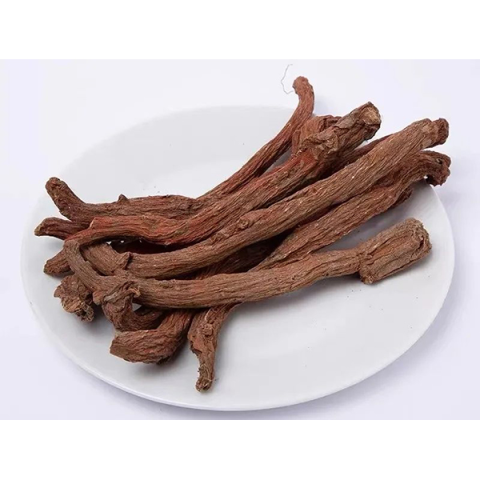

| Product name | Salvia miltiorrhiza Root |
|---|---|
| Descripción | It treats chest oppression, cardiac pain, upper abdominal and flank pain, abdominal masses, heat-induced joint pain, sleep disorders, irregular menstruation, dysmenorrhea, amenorrhea, and painful swellings such as boils, redness, and inflammation. |
| Price | MXN$500 |
| Order quantity |
|
| Sum |
Salvia miltiorrhiza Root
(丹参 · Dānshēn)
English name: Danshen / Red Sage Root / Salvia miltiorrhiza Root
Botanical source: The dried root and rhizome of Salvia miltiorrhiza Bge. (Family Lamiaceae)
Danshen is harvested in spring and autumn, cleaned and dried. It is widely distributed across most regions of China.
It has the functions of invigorating the blood, removing blood stasis, regulating menstruation and relieving pain, clearing the Heart to calm irritability, and cooling the blood to resolve abscesses.
Indications include chest impediment and heart pain, epigastric and hypochondriac pain, abdominal masses, painful Bi syndrome with heat, irritability and insomnia, irregular menstruation, dysmenorrhea, amenorrhea, and sores with swelling and pain.
Medicinal Part (入药部位)
- Root and rhizome of the plant (Salvia miltiorrhiza root & rhizome)
Properties (性味)
- Taste: Bitter (苦)
- Nature: Slightly cold (微寒)
Meridians Entered (归经)
- Heart meridian (心经) – Heart
- Liver meridian (肝经) – Liver
Functions (功效)
- Invigorates blood and dispels stasis (活血祛瘀)
- Regulates menstruation and alleviates pain (通经止痛)
- Clears the Heart and relieves irritability (清心除烦)
- Cools the blood and resolves abscesses (凉血消痈)
Indications (主治)
Used for:
- Chest impediment with heart pain (胸痹心痛)
- Epigastric & hypochondriac pain (脘腹胁痛)
- Abdominal masses, accumulations (症瘕积聚)
- Heat-type Bi syndrome with pain (热痹疼痛)
- Irritability, insomnia (心烦不眠)
- Irregular menstruation (月经不调)
- Dysmenorrhea, amenorrhea (痛经,经闭)
- Sores, ulcers, swelling and pain (疮疡肿痛)
Classical Formula Combinations (相关配伍)
1. For miscarriage with continuous uterine bleeding
丹参 (Danshen · Salvia miltiorrhiza root) — 12 liang
Cut into coarse pieces, decoct in 5 sheng of clear wine until 3 sheng remain.
Take 1 sheng warm, 3 times daily.
Source: 《千金方》
2. For cold hernia abdominal pain
Lower abdominal and genital pain pulling upward, spontaneous cold sweating, near collapse.
Use 丹参 (Danshen) 1 liang, ground into powder.
Take 2 qian with hot wine.
Source: 《圣惠方》
3. For burns by hot oil or fire—relieve pain and promote tissue regeneration
丹参 (Danshen) — 8 liang, cut
Mix with water into a paste, add 2 jin of sheep fat,
Boil three times, apply to the affected area.
Source: 《肘后方》
Dosage & Administration (用法用量)
- Decoction: 10–15 g
- For stronger blood-invigorating effect, use wine-processed Danshen (酒丹参).
Contraindications (禁忌)
- Incompatible with Veratrum (藜芦, Veratrum nigrum)
- Use with caution in patients without blood stasis
Processing (炮制)
1. Collection & Processing
- Harvest in spring or autumn, remove soil, dry thoroughly.
2. Processing Methods
(1) Danshen (raw root)
Remove debris and residual stems; wash, moisten, slice thickly, dry.
(2) Wine-processed Danshen (酒丹参)
Mix Danshen slices with yellow rice wine, allow to moisten thoroughly,
stir-fry with gentle heat until aromatic, cool and store.
Botanical Description (生理特性)
- Perennial herb, 30–80 cm high
- Roots long, cylindrical, reddish-brown to vermilion skin
- Stems quadrangular, upper part branched
- Leaves opposite, pinnately compound with 3–5 leaflets
- Flowers in whorled racemes, blue-purple, bilabiate
- Nutlets oblong, dark brown to black when mature
- Flowering: May–October
- Fruiting: June–November
Growth Environment (生长环境)
Grows on:
- Sunny hillsides
- Grasslands, stream banks
- Roadsides, forest margins
Distributed across most regions of China.
Identification (鉴别)
Crude drug appearance
1. Wild Danshen
- Rhizome short and thick
- Roots cylindrical, slightly curved, 10–20 cm long
- Diameter 0.3–1 cm
- Surface reddish-brown to dark red-brown, rough with longitudinal wrinkles
- Older roots have loose bark, often purple-brown, flaking
- Texture hard and brittle
- Cross-section loose or slightly compact; cortex reddish-brown; wood gray-yellow or purple-brown
- Vascular bundles arranged radially
- Slight odor, slightly bitter-astringent taste
2. Cultivated Danshen
- Thicker and larger, 0.5–1.5 cm diameter
- Surface red-brown; bark tightly adherent
- Section more compact and keratinous
Prepared slices (饮片性状)
1. Danshen slices
- Round or oval thick slices
- Outer surface reddish-brown
- Cut surface dense or slightly cracked with radial lines
- Cortex reddish-brown; wood gray-yellow or purple-brown
- Slight odor, slightly bitter and astringent taste
2. Wine-processed Danshen (酒丹参)
- Similar appearance but dark reddish-brown
- Slight wine aroma
Classical Commentaries (相关论述)
《本草纲目》
“Invigorates blood, opens the Heart envelop, treats hernia pain.”
《本经》
“Dispels pathogenic qi in the Heart and abdomen, relieves abdominal rumbling, treats cold-heat accumulations, dissolves masses, stops irritability and fullness, benefits qi.”
《别录》
“Nourishes blood, eliminates chronic abdominal disorders and stagnation, treats weakness of the lower back and legs, dispels wind-heat retention. Long-term use benefits health.”


